Using Raw Linseed Oil and Brick on a Tabouret Stool
It's not hard to find articles that deal with finishing wood when a simple oil finish is applied. So what I wanted to do was show how well oil finishes really work and how beautiful they can truly be.
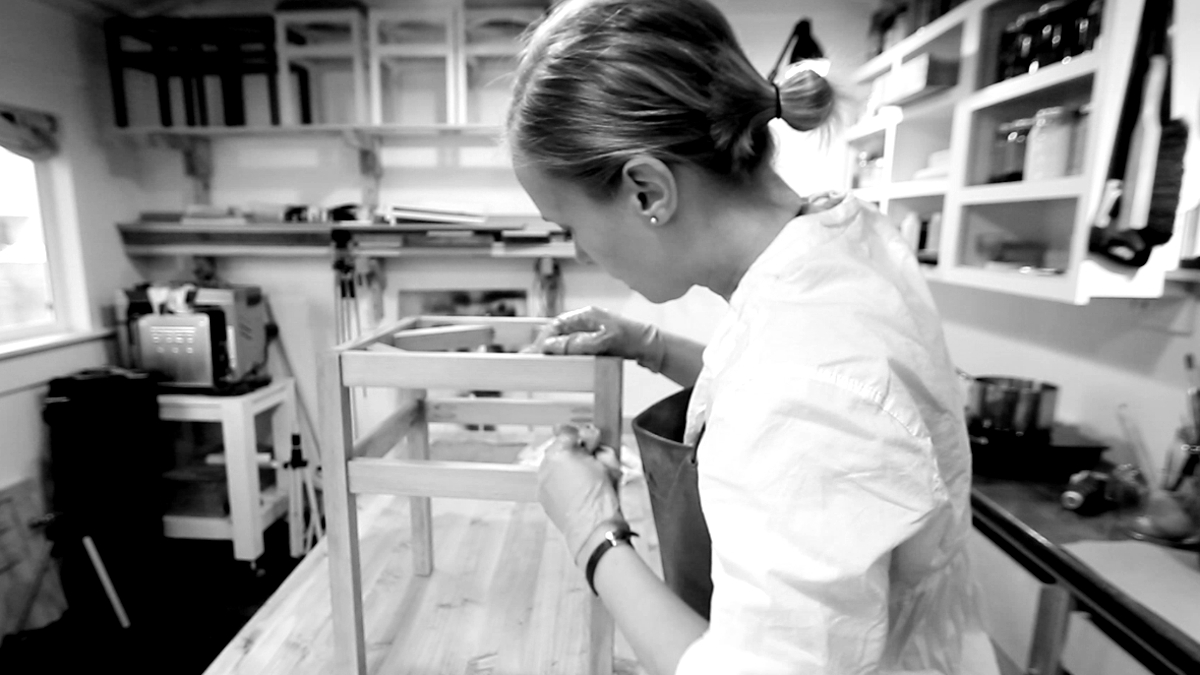
Working in my shop.
As one of the most inexpensive and safest choices, you have to wonder what is wrong with oil that it is generally passed over in favor of costly and toxic alternatives. For the most part it is the lack of permanence that turns people away from using oil in any real way. It is usually added to pop the grain of a wood with mineral spirits in a wash application. This is especially true for linseed oil as it has a great ability to highlight the grain of most woods from walnut to mahogany to fir.
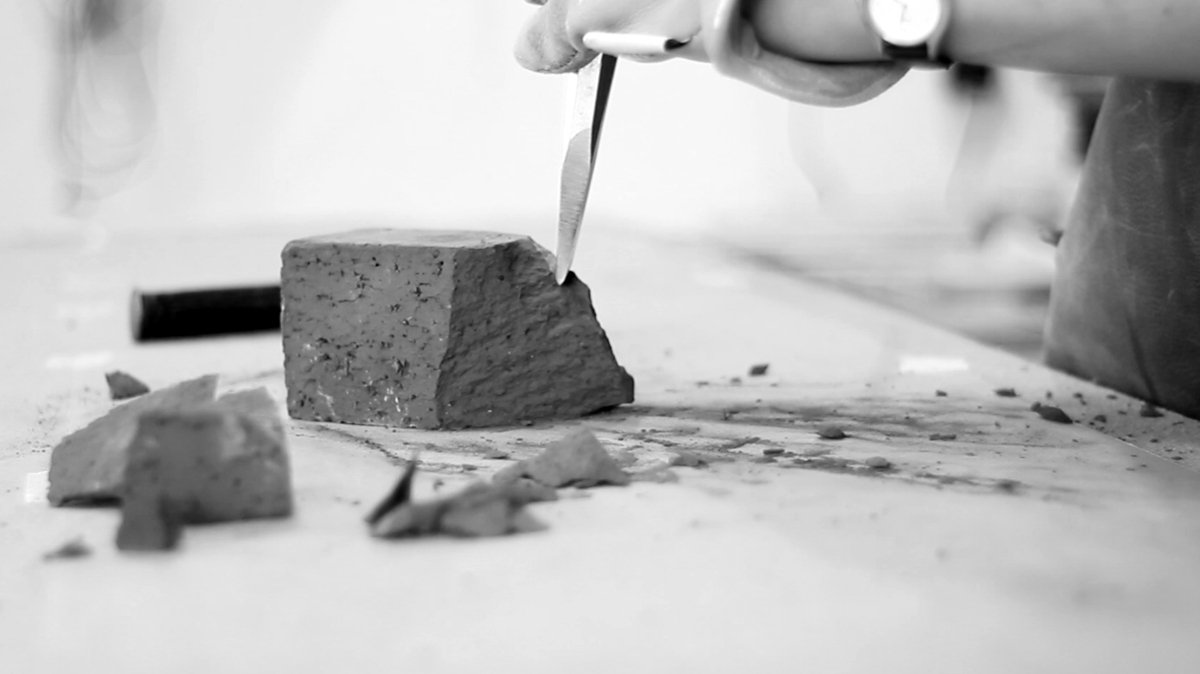
Breaking the brick with a chisel.
I decided to try an old idea by mixing brick dust with raw linseed oil and applying the slurry to the wood with a cloth. I originally learned of this by reading the writings of Thomas Sheraton, an eighteenth century furniture designer.
Immediately this concept appeals to me. Sometimes you are just drawn to quality, and this is one of those times. Because it takes time and space and energy, you form a bond with each piece that starts the furniture off on a path that you just know will be appreciated for a long time to come. When you do not apply a film finish the wood remains exposed to the elements. Sunlight, moisture, hands, and feet all wear on the wood with each year. The furniture becomes darker from the air and the light, and where hands grab the piece the edge is smoother than another as the oil remains like a fingerprint that is unique to your family.
To complement the oil the brick adds a reddish grit that makes it feel like a sandpaper slurry. You can apply it with a cloth or paper towels, but you might need a lot of paper towels because of the abrasive nature of the mix.
Method
To make the mix you create a dust with a piece of a real brick. You can't use a modern brick, make sure it is a real fired clay brick. Modern “bricks” are really concrete and contain gravel, which does not easily grind to dust.

Iron mortar and pestle.
I first break up the brick with a cold chisel and then I use an iron mortar and pestle to create the fine powder, but you could use a marble or stone one instead. If you don't have a mortar and pestle you can use a hammer with a brick wrapped in some towels and crush it on a concrete driveway or garage floor. Of course you may damage your floor so consider that before grabbing your sledge hammer. Getting the brick to the powder stage will be difficult without the mortar.
In terms of proportions I added about a 1/2 cup of dust per 2 cups of linseed oil, by volume. You should experiment to find the proportion you like best. I also added heat to the mix on my induction top. I never let the oil go above 140 degrees because there is no need to. You don't want to cook the wood, just make the slurry easier to apply and adhere to the wood. Things don't generally go on well when they are cold.
Use a cloth to apply the mix generously to the wood. It doesn't matter if it drips or gets all over the place. I just wipe the excess into the workbench anyway. Of course the brick is very gritty and when it dries it gets everywhere.
When you let the piece dry make sure you put it somewhere that is dry. A cold, damp garage is probably not the best place for it. I wait about 2 days to wipe off the excess oil and grit, but you can adjust that to your schedule. When the piece is “fully” dry you can add another coat of the mix. That should be about 2 weeks or so, depending on where it is drying. Again wait a good while before wiping it off. I like to let the piece in the sun for a good while after it is oiled. It darkens quite a bit in the sunlight.
You can add as many coats as you want and let it age as much as you want. But eventually I am going to add a coat of wax made of turpentine and beeswax to finish it.
Over time you should wipe the piece down with mineral spirits to remove the wax and prepare it for more straight linseed oil. I would say every year or so you want to add additional oil, or even more often if you like. You can also add wax whenever you wish to revive the finish.
Paint a Tabouret with Chalk-Style Paint
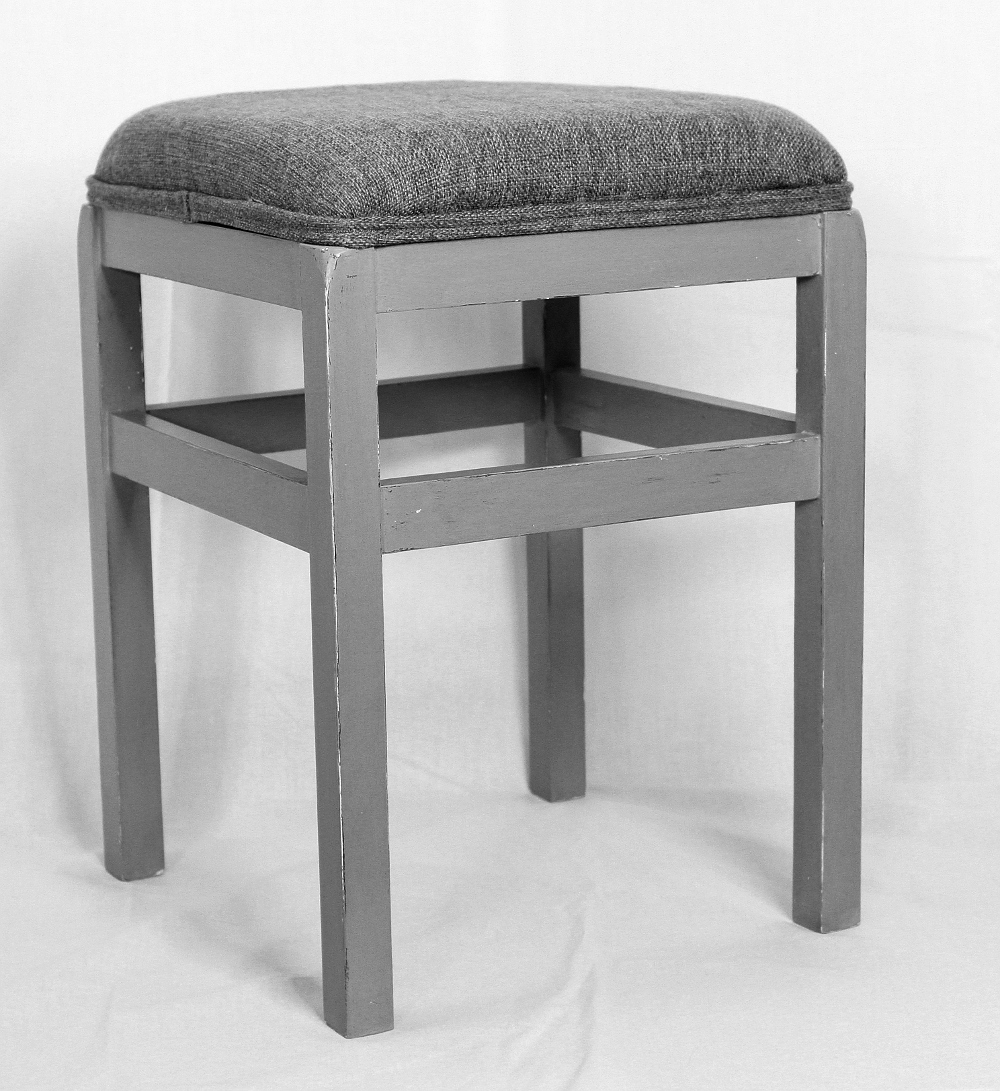
Finished Tabouret
Chalk-Painting the Tabouret
For our next project, we decided to go for chalk paint. Chalk paint has become quite popular these last couple of years, however it's not a new concept at all. In fact, many old-fashioned milk paint recipes contained chalk which blur the lines between chalk paint and milk paint.
Chalk paint is not one thing - it's a concept. You can either buy pre-made chalk paint, or you make your own. The fundamental principle is to use flat latex paint and add a chalk component to produce a thicker paint that coats surfaces easily.
Why are people liking this type of paint so much? Well, it goes on most surfaces very easily, even furniture that hasn't been sanded or primed. That makes it an ideal candidate for old pieces, kitchen cabinets, or other projects where you want to eliminate the sometimes great amount of prep work. The chalky nature of chalk paint also produces a very matte finish which creates an interesting, antique-style look.
In terms of the chalking material you have a couple of different options such as Sodium BiCarbonate, Calcium Carbonate, Plaster of Paris and Grout to choose from. Each material produce a slightly different result:
- Sodium BiCarbonate (baking soda) is a common household supply. Sodium BiCarbonate dissolves in water (or latex paint). In paint, that results in a chalky or sandy finish which is easy to sand down.
- Calcium Carbonate is what common drawing chalk is made of. It's normally sold as a fine powder, and is what historically was used when creating this type of paint. Calcium carbonate makes a great chalk paint, which doesn't harden and is easy to work with. The one downside with Calcium Carbonate is that it can be a little tricky to find. Order it online, or check out your local home brewing supply store. You could also buy a few packs of regular chalk sticks and smash them up in a mortar and pestle, or use a plastic bag and a hammer (it's important to create a fine powder.)
- Plaster of Paris is a commonly available substance used in construction and patching up walls. The one downside with Plaster of Paris is that it hardens when it comes in contact with water, so your mixed paint can harden rather quickly depending on how much water you add to the slurry. Tip - make smaller batches of paint, if you're working on a big piece of furniture.
- Grout is also commonly available at your home improvement store. It's a slightly more coarse material and is similar to Plaster of Paris in that it hardens when it comes into contact with water. Again, start out with mixing smaller amounts to avoid having your paint harden before you finish your project.
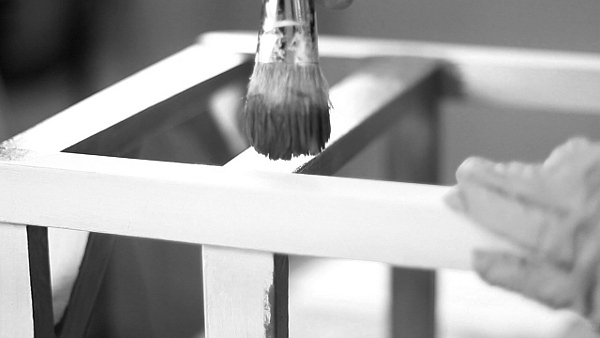
Materials Needed:
- 2 different colored flat latex paints of your choice (paint samples works great for smaller projects)
- Chalk component (either Calcium Carbonate, baking soda, Plaster of Paris or grout)
- Calcium Carbonate: 1:1 mix worked well for us.
- Baking Soda: 2 parts paint 1part soda seems to work well or try a slurry or baking soda and a little water then mix in paint
- Plaster of Paris: 2 parts plaster and 1 part paint, but mix a slurry first
- Grout: use unsanded and try a 2:1 mix with a slurry
With all these choices it is in your interest to experiment and try it out on a scrap piece of wood.
- Two small containers to mix paints in
- Small whisk or stir stick
- Nylon brush
- Fine Sandpaper 220 grit
- Rag for cleaning
- Clear wax (steel wool or rag for applying)
- Dark wax
Method:
Creating Chalk Paint
For our project we used Calcium Carbonate. Your ratios depend on what your surface is like and how much coverage you're looking for (the ratios will be different if you go for baking sofa, Plaster of Paris or grout, see above).
For our first coat we combined 2 parts Calcium Carbonate to 3 parts paint. This created a paint that resulted in a nice, chalky surface, however it didn't go on that thick. For our second coat we combined equal parts Calcium Carbonate to flat latex paint to create a thicker paint.
Make sure you start with a clean surface, especially if using an old piece of furniture. We started with a primed and sanded stool to ensure a really good base coat. Even though priming always ensures a better surface for any paint to grip on to, when it comes to chalk paint you can often get away with skipping this step.
For the first coat of paint, we used a dark red color. Chalk paint dries quickly and chalky, so you can re-coat within an hour or so.
For our second coat we used a lighter turquoise paint which covered the red surface nicely. If you're looking to achieve a layered look, make sure your two different colors are different enough to create a contrast.
Coverage:
Since chalk-paint contains such fine particles, it does a great job in getting into all the little nooks and crannies in a furniture finish. In other words - it's easy to accomplish a really nice surface. You don't have to be too concerned about putting on a perfect coat. Unlike glossy paint, your brushstrokes don't show up much, and since sanding is part of the design it furthers smooths out the surface.
Sanding:
Once your paint has dried, bring out some fine sandpaper and lightly go over your whole piece to smooth it down. If you're looking to create a more layered look, start sanding the edges and corners to reveal some of the underneath coat. How heavily you sand is a matter of taste. Some people prefer a rather heavily distressed finish while others prefer a more subtle look.
Top Coat
Since chalk paint is so flat and chalky, it's imperative that you protect the surface in some way. Wax has become the go-to finish for many people who use chalk paint and wax is easy to apply and looks great, however it's not that durable. If you're finishing a piece of furniture that will be handled a lot - such as a table top or seat for example, it can be a good idea to first apply a coat of polyurethane or shellac to add further protection. You can always add wax on top of that. If you only apply wax on a finish that gets worn a lot - be prepared to reapply the wax every so often to provide protection.
Wax
We decided to go the classic route and use two waxes - one clear and one dark. When applying wax, you cover your piece with it, then let it penetrate the surface of the wood, and then you wipe off the excess. Wiping off the excess is an important step which will create a smooth finish and avoids any build-up of unwanted finish.
For the first coat of wax, we applied it with 0000 (fine) steel wool to further work it into the finish and create a smooth texture. After a few minutes, it's time to buff off the excess with a clean cloth.
Wax applies easier if it's warm, so for our second coat we warmed a lump of dark wax in the hand covered with a cloth. Once the wax turned soft and slightly warm, you wrap the cloth around it into a small ball. With the softened wax inside the cloth, you can easily apply the wax all over your piece.
Dark wax adds additional dimension to the design and fills in nooks and crannies, further creating a layered look. Once the wax dries off, buff off the excess for a smooth and beautiful finish.
Design:
Using chalk paint is a great way to go if you're looking to add more character and depth to your piece. It's a nice option, no matter whether you're refinishing an old piece, or you're finishing a brand new piece. Also, if you haven't worked with chalk paint, you'll be pleasantly surprised how lovely it is to use - the coverage is great, it dries quickly and you have so much flexibility in creating a unique look. If you decide to go for a wax finish, you'll also appreciate the silky smooth finish this method produces.
White Washing A Tabouret
Just after the first coat.
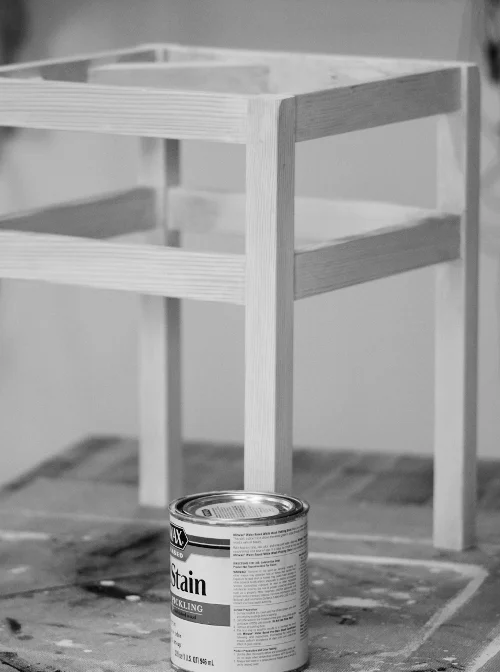
For our first post about finishing techniques we decided to try a very popular process called White Washing. There are a few ways to achieve this look and we will be using the Minwax product called “Wood Stain: White Wash Pickling” to really give us a way to make this look as easy as possible.
Now years ago this technique was not as popular as it has become recently. In fact it was a rather unpopular finish because it represented a certain lack of money for paint that some people would have rather not projected to others. The Joneses really wanted to be able to afford paint, but sometimes it was easier to obtain the basic ingredients to just make the white wash themselves.
White wash was designed to be cheap and protect wood, brick or concrete. Although fine furniture was not generally white-washed because of the difficultly in application (and people who bought fine-furniture didn't usually have a money problem), in our time is has become a popular look along with distressing and chalk paint. At least now we just really want the look and not necessarily the protection because we can just add a top coat of polyurethane or other clear varnish to the final product.
The process according to the can is basically similar to other stains in that you lay it on and wait for a few minutes and rub the excess off. You can repeat the process to obtain the look you are going for. Applying the stain once only generates a minimal whitening, we ended up doing it about 3 times for a substantial whitening. This product from Minwax is water-based, unlike most stains, so it cleans up pretty easy with soap and water and doesn't smell much.
In terms of indoor-friendly, or apartment-friendly it ranks pretty high since you can use water for cleanup and it doesn't require even a brush to apply, and your neighbors won't smell it. You can just rely on some windows for ventilation and you'll be all set.
White Wash Technique I
Material or Tools Needed:
- One beautiful Darbin Orvar Unfinished Tabouret, or other unfinished furniture
- One Quart of Minwax Wood Stain: White Wash Pickling
- Rags or Paper Towels
- Brush (Optional)
- Stir stick for can
Method:
Stir the stain, or shake the can if you are going to apply with rags or paper towels.

...continuing to wipe off the excess stain.
Dip the towel into the stain and wipe on the furniture. It is fine to rub in the stain and keep applying everywhere. If the piece of furniture you are working with is large then do only parts at a time so that you don't let the stain dry. The stools are small enough to completely stain and then take a clean towel or multiple paper towels and wipe off any excess. The can says to repeat if necessary and let stand at least 2 hours between coats, and not to sand between coats. We could not see any reasons to modify this so we followed these directions.
White Wash Technique II
Materials or Tools Needed:
- One can (depends on size of furniture, one tabouret requires about 1 pint) of your favorite latex paint
- One decent nylon brush
- One small bucket or coffee can to mix paint with water
- Some water for mixing
Method:
Make sure you don't thin out all your paint at once. Do a little at a time to make sure you've got the right consistency. Mix 4 parts paint to one part water and test on a scrap piece and see if you need to add additional water. You will probably want to add more water but check first before you must commit.
To apply just paint it on and you should right away see what it looks like on your furniture. If you are applying this on a tabouret then you should see the grain of the wood clearly.
One benefit of using thinned paint instead of wood stain is that you don't really need to have an unfinished piece of furniture. You could sand down an existing finish and try it there.
Top Coats

Creating the pad by enclosing one towel inside another.
For our project we decided to shellac the stool. Because it is the final coat I chose a clear variety containing wax. Instead of brushing the shellac right on the work I wanted to pad it on by wrapping one cloth inside another cloth and adding the shellac to it lightly. The reason for this method is because it is very easy to get drips with a brush as shellac is quite thin and watery, even though it has an alcohol base.
Because it has an alcohol base it dries very fast and you can pad on multiple coats in a few minutes. So I added a few complete coats to the stool, waited about 2 hours and then sanded very lightly with 220 grit paper and returned to the padding process for another once over.
Shellac is also very apartment-friendly because it has very little odor and it is non-toxic. In fact you can apply shellac with a spray can outside and get a great simple finish that is safe for children and pets when dry.
For a soft satin feel I added with a clear wax with 0000 steel wool and then polished it off with a clean cloth. You can simply reapply the wax whenever you like and there you have a safe kid and pet-friendly piece of furniture that will last a lifetime.