DIY Building & Designing an Art Shelf

Watch the Video: DIY Building and Designing Art Shelves
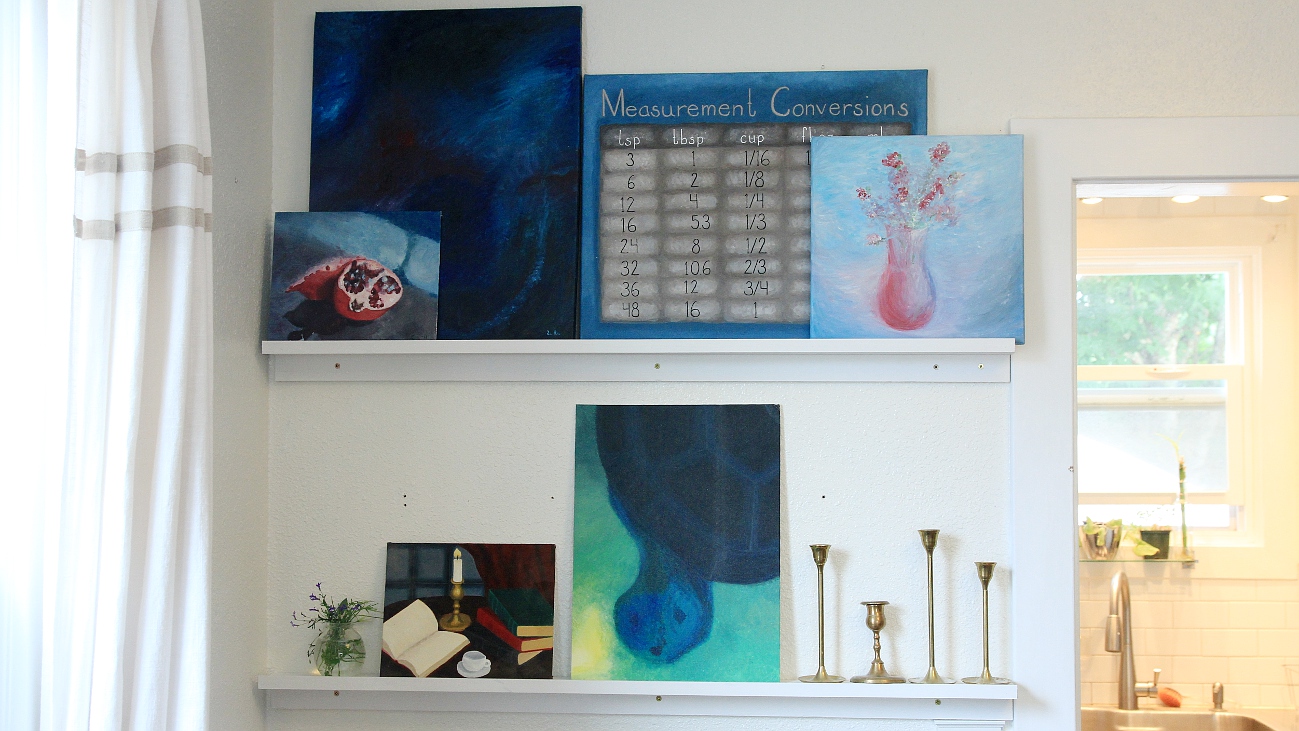
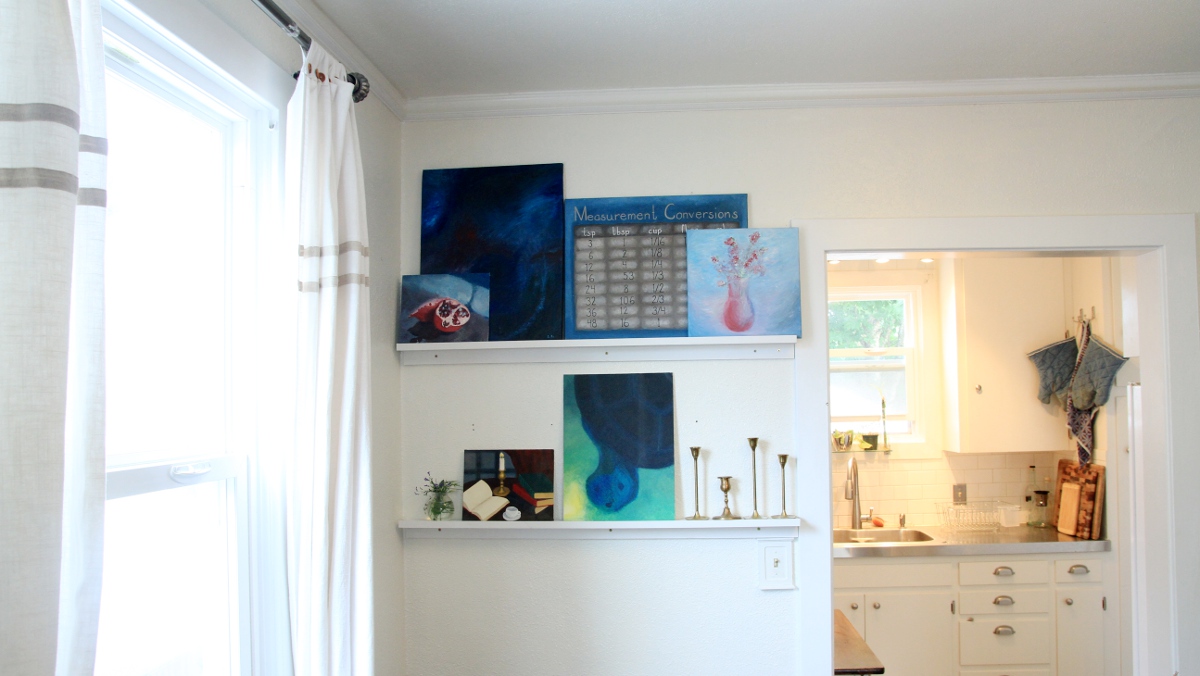
I started with measuring and cutting up the wood for the shelves on my table saw and miter saw. I started with a 1x6 that I ripped down to 3 1/2 inches for my top shelf, and the underneath bracket I ripped to 1 1/2 inches. I cut them both to 43 inches on the miter saw. However at the home improvement store you can find 1x3 and 1x2 whitewood boards which would be perfect here, and then you wouldn't need to rip any wood at all, and you could use a simple hand saw to cut the wood to length, or you could have them do it for you at the store.
I made the shelves 43 inches long to fit the wall, however you could make them any size you wanted.
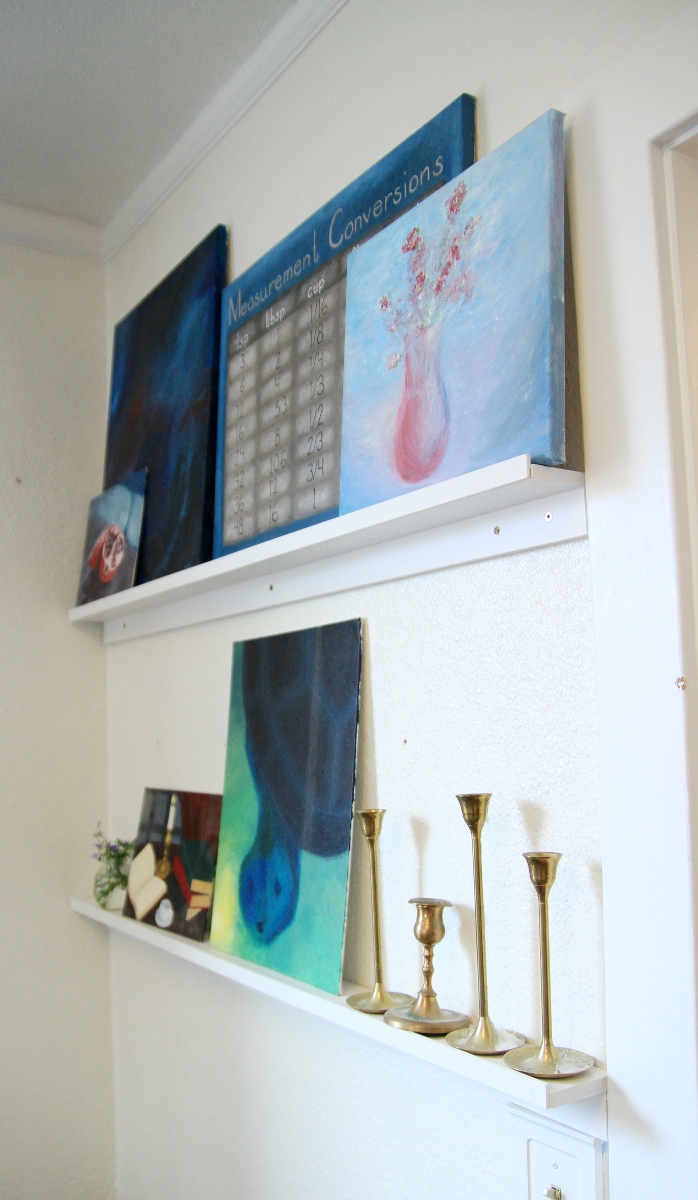
These kinds of shelves are really nice because you don't any brackets because they're so shallow.
To assemble, I glued one piece on top of the other and used my brad-nailer to secure it in place. However you could use just 1 1/4 inch drywall screws or glue and handfinished nails.
I also decided to use a thin strip of wood on the edge of the shelf for a lip, however this is a completely optional part that you don't really need to do, because most things are going to stay on the shelf just fine without it.
After some painting, these guys were ready to be put up on the wall.
Shop Tour 2014 - My Creative Space
Check out my new video where I take you on a tour of my new workshop and my old workshop. Complete with tools, organization and some photos of building it.


DIY Beeswax Polish Mix on Furniture
After almost 8 weeks the brick dust with linseed oil finish is ready for the beeswax polish. The stool has been curing, in the sun, on the shelf and in the air for a while now. The colors are complex and the piece really has an aged look, very similar to the honeyed fir floors in some older homes. The sun-baking process created a variety of color changes, depending on where and for how long the sun was able to reach the surface.
This process is very similar to how bricks are created in hot ovens, the color depends on how close the bricks are to the heat source. The whole piece has a very organic nature to it. This is as far from plastic as you can get.
I prepared the surface by sanding with a 220 grit and decided to smooth it further to 320. Contrary to my expectations the surface was not oily at all, despite using a raw linseed oil over a number of weeks. I think the sun is really a key ingredient to curing the oil and making sure the oil has dried properly.
Whenever you are using oil and a wax finish like this there is even more pressure to get the wood right. Sanding and smoothing are critical, and glue squeeze-out is a real problem because you can see any imperfection so easily.
Beeswax Finish
A beeswax finish is one of the oldest and most natural methods for finishing furniture. Waxing in general is a simple method for achieving a very smooth silky surface on any properly prepared wood. It would be hard to find a finish simpler or easier than this.
You can place this wax on top of just about anything. In some of my earlier videos you will have seen me apply wax over paint, polyurethane, oil and shellac, it is just that versatile. Most of the reason people like wax is the very smooth feel you get with it. Typically it does take the shine off a glossy finish like polyurethane and therefore makes the wood look more natural according to some, and I agree. Too much gloss does have an unnatural look.
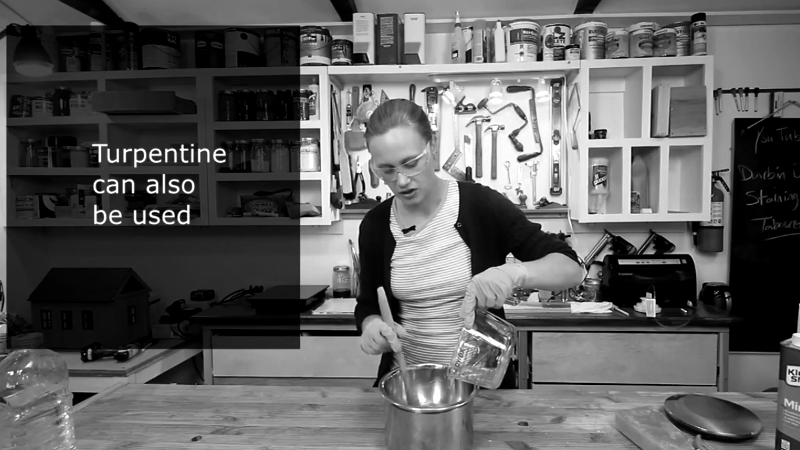
To make your own mix is pretty easy. You can buy beeswax online or locally from an apiary, and it comes in blocks or cut up in bags. Melt the beeswax and add the mineral spirits to create your mix. You can play with the ratios but 1:1 seems like a good number for general use in terms of waxing furniture. If you add too much solvent sooner or later it will not solidify at all. A 4:1 (solvent : wax) mix might be better for brushing on the wax though as it would be a lot softer.
There are lots of paste waxes on the market and for the most part they are pretty similar. They usually contain beeswax, carnauba, paraffin, solvents and scents in a variety of proportions. When you make your own you can really play with the mix, adding more or less of any ingredient you wish.
Over the next few weeks I will be exploring further into these concepts with waxes, oils, scented oils, and pigments. Hope you stay tuned.
If you would like to watch the process of creating the wax polish check it out here:
Building a Tiny Tiny House with a 2 x 4

Using Milk Paint on the Tiny House.
A tiny house in the woods, hidden away from the world. That sounds like something I could get used to. A place to read, think and live, without the concern of others. Of course it's not so much a far removed dream at all, because there are many people who are actually doing that. Perhaps not moving out to the woods, but taking back control over their lives, and creating something for themselves that gives them more freedom.
People are taking back their skills. While you may hear on the news that people are unskilled – there are many people who are re-learning what their parents and grandparents tried to get away from while they hid away in the suburbs or packed themselves into the cities. Skills on how to build, grow food and live independently were seemingly lost to the industrial process.
There's nobody telling anyone to go and pick up that hammer and learn how to build a tiny house. They do it often because they want to take back their economic power. They don't want to work a job they don't necessarily love, just to keep up a standard they don't necessarily need. I think it comes back to freedom ultimately here, and people are revolting, it's just not very loud, or large.
I hope it stays quiet though, and underground. I think the danger would be to institutionalize these efforts. Under a false premise some want an authority involved to create laws, incentives and kickbacks to get people to do something they already are. But it is better to leave it alone. I love that people are trying new things, however I think it's when you want everybody to act the way you think they should, that it becomes a problem. I think we should watch out from trying to make a movement like this too formal, that's when you make it worse. The beginning is always better than the end.
When you build a house for yourself you are confronted with things you normally don't interact with. Most people are far-removed from the process of building and construction, they generally don't think about the forces that affect a house. Forces such as weights, wind and water, or resources like electricity are often left for another to think about. Building a house, building furniture – making anything really, is a journey in problem solving. Figuring things out as you go along, because you have no other choice.
When building your own house, you're in control, and for better or worse you don't necessarily have to conform to convention. In my tiny house model I wanted 24 inch centers instead of 16. It is funny how we tend to see the number of timbers as important but fail to realize the most damaging force affecting a structure is water. And then I also realize how I can fit 2 foot wide windows without needing headers, saving material and weight. As you can see in my 1/12 scale model, it definitely looks proportional. When building a structure you're forced to think of spacing - wasted space is unappealing as is wasted wood. It's appealing when things are in order, when it fits, and we usually just know when it does.
It's not that I think that using less material is good in and of itself, especially if you need it. But if you don't, then why waste them. Along the same lines – I don't think that living big is necessarily bad. As someone who does a lot of projects – you often need a lot of space to do things, and there is nothing wrong with that. Even though you can write a book in a tiny house – you can't necessarily build large things, piece a quilt together or paint large canvases. But then again, not everybody wants to do that.
In many ways, the individual does not need much to live and thrive. Every great thing started with a table and a chair. You can sleep on the ground, you can leave comfort behind, but you work at a table, sit on a chair, write with a pen, study books and observe the world around you.
Fundamentally, I don't want a world where anybody tells you what you should be doing, you should do what you want. And if you want to learn how to build your own tiny house and live differently from the way your parents did, you should, and that's just the kind of dynamic world we should want. I think this whole process is very much about learning and realizing that success is not necessarily income. So many people who have contributed great amounts to the world were not well off – it's much more interesting to be curious and learn things along the way. So in that sense – success is about knowing more so you can make better choices for yourself and your future.
So what does a structure mean to a human life? I think a home, a house, a place of your own, is so fundamentally important to one's happiness. If freedom is the control of one's self then you must have the space in which to exercise the self-control to be free.
While listening to the news, you sometimes get a sense that people are no longer interested in have a home. Well, maybe to some extent that's true, but perhaps only in the conventional sense. I think most people want something of their own, they might just not want a mortgage and the limited freedom that comes with a traditional life. The tiny house movement, while being focused on sustainability and one's environmental impact, I think when it comes down to it, is really about people taking control of their economic future, and taking back their skills and independence, striving to live more authentic lives.
If you would like to see how I built this tiny model home please take a look at my channel and subscribe:
Using a Varnish Oil and Thinking about Durability
There are a few different concepts I wanted to cover in this week's blog and video. So this is less of a project piece and more of a thought piece. Not everyone is concerned with what I am concerned with but please bare with me as I go over what I think is a subject deserving of more coverage.

Last week I made a sort of silent film where I constructed a sheet music box and finished it with a wipe-on varnish oil. Because it was silent I did not go into why I chose it nor how I came upon the product. I covered some of this in the last blog post but I want to expand upon some of the things I was concerned with in the Fine Woodworking piece I referred to last week.
A round up of products is always questionable. Did you include every product? Or, is there any bias in the tester? And so on. Letting go of those points for a minute I suppose there were really two points that struck me about the article. Firstly, Chris Minick is a scientist by trade, and product reviews are definitely not science. Second, I thought it was questionable to have a product round-up including oils, strongly oil-based finishes and a variety of wipe-on varnishes including polyurethane. Granted that the article was about wipe-on finishes, but why then would you have a set of criteria which when reviewed even cursively by a beginner would yield the same conclusion as the lab-coated reviewer?
To put this plainly: reviewing a product is not science. Science is to discover that which is unknown, these products are clearly known. Anyone even mildly familiar with finishes would not compare wipe-on type oils such as Watco Danish Oil or Boiled Linseed Oil in the same breath with a wipe-on poly where the criteria were strictly durability and water/heat resistance. Finishers use Waterlox Original Sealer/Finish or Tried and True Varnish Oil for very different reasons than they use other products, and durability alone rarely determines what one chooses.
I wrote to the company that makes Tried and True and asked where they saw their product. I mentioned the article by Fine Woodworking and asked them to clarify where they picture their product in relation to the polyurethanes mentioned in the round-up. In their response they believed that their product is not meant to compete against polyurethanes.
Given that, it is not hard to see that craftsmen of all types choose their finishes for more than just the simple concept of durability. Personally I am not looking for a perfect finish, or a fool-proof finish, a term I have read and heard one-too-many times. I am looking for what belongs on each and every project individually. There can't be a perfect finish for counter tops, violins, floors and sheet music boxes. Each project has different demands.
Which brings me to my next point: durability and product preservation. We often take the better-safe-than-sorry approach to finishing, especially when a client is involved. Better to go a little overboard with protection, than worry it is not enough. This makes sense. You don't want to go against a client's wishes or cause undo problems. So polyurethane and lacquers are certainly important to achieving this. So sometimes its just not worth taking the chance.
Since I made the box for myself and wanted to try something that was for myself, no clients or expectations were involved. I did not have to worry solely about durability and I could free myself and try out a product I had not used before. A can of Tried and True Varnish Oil had been sitting on my shelf for a while and this seemed like a great project to try it out on. I like to explore new finishes, so I buy a few and test them on scrap wood, later on coming back to them when an appropriate project comes up.
Such a small box doesn't need too much finish, and I could take my time applying it, so the rather finicky nature of the product could be explored. Overall I really liked the product and said as much in my last post.
I guess it comes down to what we expect and how we assume certain things in life. I often try and challenge my own assumptions about products and techniques, and one of the great problems I see is why would you use something that does not provide the utmost in protection for something that offers very little. That is the crux of the varnish vs. oil argument.
My real concern with scientific-style reviews is the misleading nature as to what science is and how it does not belong in product testing. Immediately it makes me imagine all sorts of absurd comparisons.
If I lined up water, motor-oil and olive-oil while donning my lab coat, and went on to test which was better for engine lubrication I obviously would have some instant winners. The point being water and olive-oil should not have been in the round-up to being with.
Nothing is the good-for-every-use product that everyone may want. I would not line up hard film finishes with oil. Even though many products attempt to cross the line between a varnish and an oil with varnish oils, there is some instant recognition that the durability of a finish is simply one of many factors that expert finishers consider.
The bottom line has to be that you have to do what you want to do, but know that there is no real restriction. You can safely use products in ways not necessarily recommended by the manufacturer or that are generally accepted. It's about understanding what may happen and your tolerance for accepting responsibility.